


5. The Strategy of the Snail (1993)
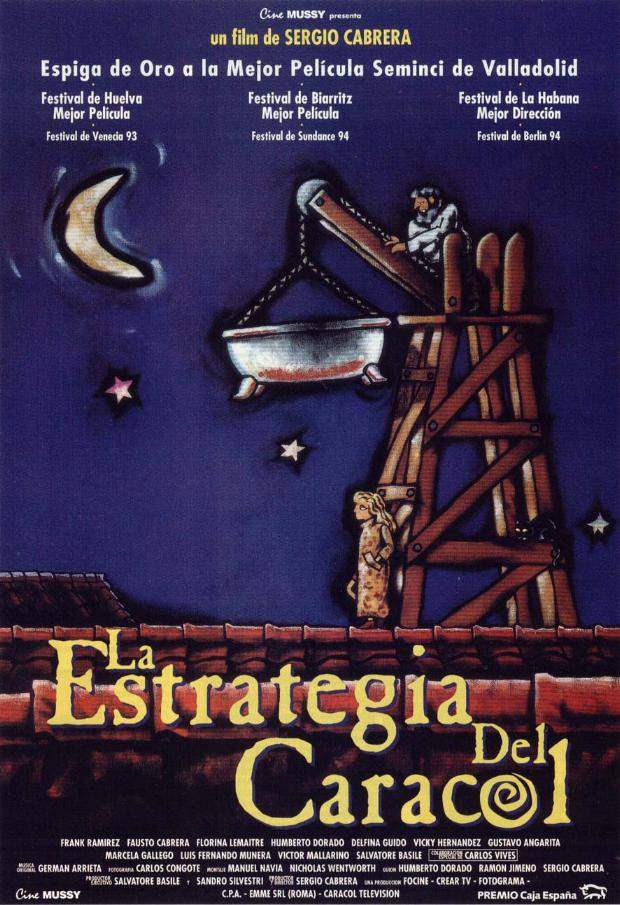
I will admit, I was surprised by how much I liked this movie. The charm of the characters, the setting, and the honorable fight make it so you can’t help but fall in love with the film. The Strategy of the Snail follows tenants of an aging Bogota mansion who are about to be kicked out by the owner. After a violent confrontation with armed forces, their lawyer realizes their best weapon is time and they begin to stall while they build a pulley system that allows them to transfer all the items in the house to a new location by the time the eviction comes. This film shows that hope can be found in even the most dire places. For this film to be set in the backdrop of a Colombia mired by the violence of the guerrilla group, FARC, it is amazing that they were able to show a peaceful way to create revolutionary change.
It really is an off-the-beaten-path, feel-good movie which encourages the left to think outside of the box when it comes to change. Solutions can be found in some of the most madcap plans. Just give it a try.
Read my full analysis here.
4. The Battle of Chile (1973-1979)

In no other documentary can the operatic drama of this Patricio Guzman masterpiece be matched. La Batalla de Chile is a three-part documentary detailing the events that led to the coup against Salvador Allende’s government on September 11, 1973. The first part follows the bourgeoisie’s role in his takedown, the second follows the military’s role, and the last part goes back in time to focus on the workers who fought against it all. The images of the film really stick with you from the shot of a cameraman shooting his own death to the collective resistance of many urban workers.
The film gives you an extensive lesson on how societies fall apart and how coups happen while still managing to be hopeful. Guzman’s message always remains “keep fighting.” How he does it? I don’t know. All I know is it works.
Read my full analysis here.
3. Pixote (1981)

Brazil never looked so wild as in this film. Pixote takes you on a crazy ride through Rio and Sao Paulo that leaves you absolutely dazed. The film follows a young boy who is rounded up by the police and placed at a reformatory. While there, he faces abuse from adults and kids alike, but when his friend is murdered by one of the adults, he and his friends decide to escape before they are unjustly framed. Once out, they are confronted with violence, drug deals, and prostitution. The film takes a hard look at the Brazilian government and the harm they have done to its children at a time when the dictatorship was finally coming to an end.
While the director, Hector Babenco, is harsh on the government, he offers a really sympathetic view of the young teenagers caught in a bad cycle. Characters like Pixote and especially Lilica make this movie more than just a violent portrait, but a meaningful one as well.
Read my full analysis here.
2. Solo Con Tu Pareja (1991)
Before there was Y Tu Mama Tambien, Cuaron made his debut with this charming and surprisingly hilarious movie. Solo Con Tu Pareja tells the story of Tomas Tomas, a young Don Juan character. When one of his scorned lovers decides to forge his STD test with a false HIV diagnosis, he begins to question his life. At a time when the PRI’s power in Mexico was coming to an end, Cuaron offered a pitch-perfect lampoon of the commercialization of Mexican history and culture. It also stands out as one of the first movies to tackle AIDS in a comedic way.
Scored perfectly to Mozart’s “Don Juan”, it finds ways to be laugh-out-loud outrageous while offering a really romantic scene on top of the Latin American Tower. With an ambiguous ending, it merits many rewatchings. Walk, don’t run to see it.
Read my full analysis here.
1. La Llorona (2019)
At the top of my list, there was only really one movie I could pick. On par with Pan’s Labyrinth, this film mixes horror with the realities of the Guatemalan Civil War so artfully that I’m surprised more people don’t know it. La Llorona tells the story of Enrique Monteverde (based on Efrain Rios Montt) who has recently been acquitted of genocide for his actions as head of state from 1982 to 1983. Protesters outside leave him and his family unable to get out of the house and a new maid with a shadowy past begins to make them face their own past and take responsibility for their actions.
The director took the sexist and dull myth of “La Llorona” and turned it into something subversive and utterly relevant. It’s a revenge story that is extremely pinpointed. This is not a chaotic story but one that knows who the enemy is, who has to pay, who has to learn, and who is next.
Read my full analysis here.
 The Cine Latino Blog
One response to “Sofia’s Top Ten List”
[…] For the English version, click here […]
LikeLike