

Para la versión en español, cliquea aquí
Synopsis
The Crime of Father Amaro (2002) begins when a young priest is sent to Almada to help take care of the aging Father Benito. Once there, he begins an affair with a teenage parishioner and soon devolves into a selfish weapon of the church leading to the excommunication of one priest and the death of his lover.
The story of The Crime of Father Amaro was already more than 100 years old by the time it was adapted in 2002. Originally published in 1875 by José Maria de Eça de Queiroz in Portugal, it became famous for its controversial storyline and depiction of the Church. It was immediately popular and resonant for many readers in the late 1800s who found echoes of Emile Zola in its story of forbidden love and immoral societal rules. Years later, Alfredo Ripstein would go on to read it and try to get it made with his successful production company, Alameda Films, which was founded in the 1940s. Though it was one of his first and most passionate ideas, it would end up becoming his final project. He hired the seasoned writer Vicente Leñero who had recently published a well-received novel satirizing the PRI’s corruption, La Ley de Herodes. His work on the film became so unique that the script for this adaptation would in turn be adapted into its own novel a year later. Featuring Gael Garcia Bernal, a star who had already made a name for himself internationally by starring in politically and sexually provocative films, this was the perfect cast and crew to bring this Portuguese novel to life.
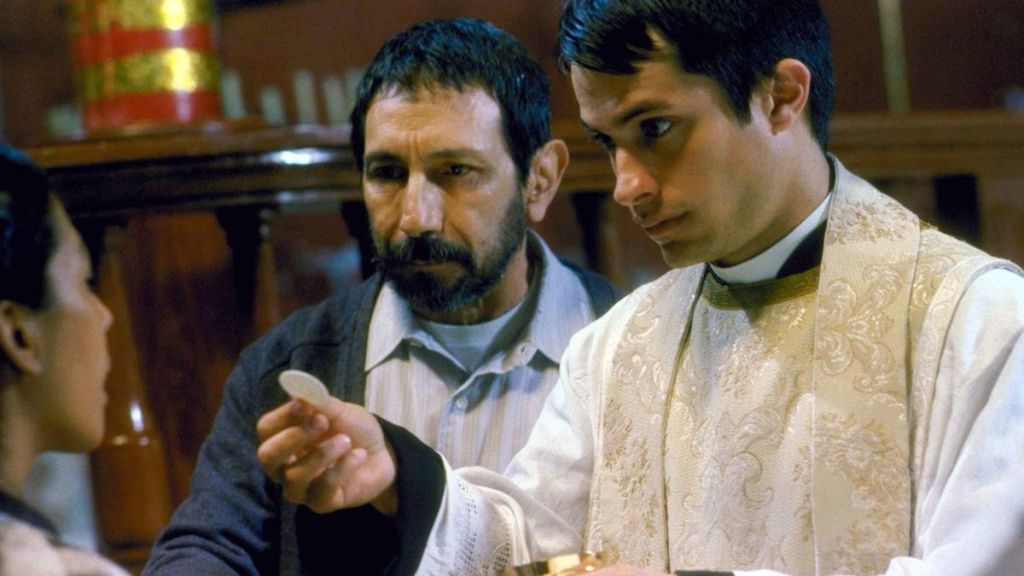
The public in Mexico was also, finally, ready for this movie in a way they had not previously been. 2 years earlier, Vicente Fox was elected as the first president not from the PRI party since 1929. Though change was in the air and many Mexican people were ready to do away with many institutions that previously held power, one institution had been growing since the early 1990s. Thanks to significant revisions to the Constitution in 1992, many laws limiting the Church’s powers were removed including articles enforcing both private and public education to be secular and those denying the Church any legal status, freedom of association, freedom of speech, and the right to vote. On a global scale, many Catholics were being forced to reckon with vast corruption as the child sex abuse scandal was broken by The Boston Globe earlier that year. As Italian historians Savarino and Mutolo write, “It is no coincidence that the anticlerical film, The Crime of Father Amaro, has been well received by the public in Mexico, as it reflects very widespread feelings and apprehensions among large sectors of the population.”
Culminating from these turbulent times, the film proved to be just as controversial as the novel was upon its release. Many including the Church and an ultraconservative political group, Pro Vida, declared, “Hopefully, our authorities will be discerning and show common sense, and not allow this film to be shown in public.” This is in large part due to the very vital changes made from the novel. Queiroz does not introduce Father Amaro until the third chapter, by which time he has allowed the reader to form a poor opinion of him. He is an aimless young man who was pushed into the priesthood by his aristocratic patrons and has already shown himself to be selfish. The film’s opening is entirely different. He is introduced almost immediately and shown to be a kindhearted person when, after the bus, he is riding on is robbed, he decides to give an old man money. The Church does not magnify his evil, it creates it.
His blind obedience in the hopes of becoming a powerful priest who can affect change leads him to moral ruin. Though he begins as a naive and pure young priest, his bishop’s direct orders lead him astray. When he is forced to write a rebuttal to the local newspaper’s exposé on Father Benito’s known association with local narcos, he does not fight it and his cowardice only grows from there. When the newspaper says they can choose to not run the article, he doesn’t fight either. He just alludes to the fact that they may have trouble with advertising later. Anytime, he is challenged he can simply rely on the structures of the Church. After kissing Amelia for the first time, she goes to confession and he asks her what her sins are. When she retorts by asking what his are, he says nothing. The confessional booth is only supposed to go one way. Even when Father Benito finds out and tries to confront him, he does by confessing Amaro’s sins to him.
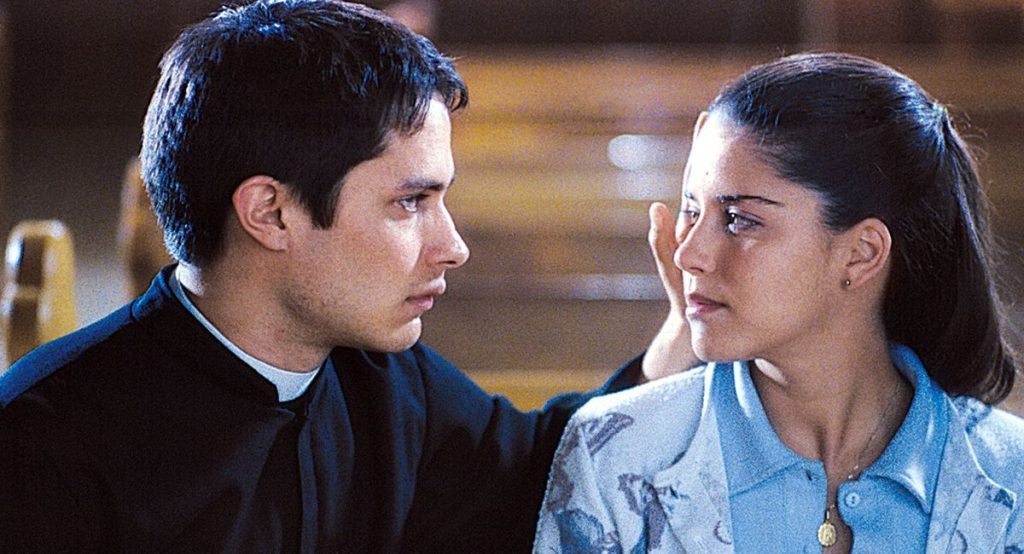
By the time Amaro meets the old man from the bus again at the end of the movie, he is a completely different person. Though he is more respected by the Church, he has devolved into someone who would force his secret lover to get an abortion to relieve him. Modern additions like the abortion add color and relevance that was needed for this adaptation. Making this old Portuguese novel relatable for contemporary Mexican audiences also required the inclusion of two other aspects: narcos and liberation theology allowing for a very different fate for Father Ferrão (Natalio in the film). In the novel, Father Ferrão is the only likable priest and comforts Amelia. His film counterpart, Father Natalio, is much more politically active and therefore more despised and punished. Though Father Benito is linked to narcos and Amaro is having an affair, he is the one who is excommunicated for housing guerrillas and preaching against the narcos.
Meanwhile, Father Amaro becomes more and more admired within the Church even as his selfishness grows. Just like the many other priests that were finally being exposed at this time, he is absolved by the silence of his witnesses. The mentally disabled Getsemani and Father Benito, who suffers a fall can’t speak out against him. Even though Father Benito is at the beck and call of the narcos, Father Amaro still manages to be worse and leave more victims in his wake. Clearly, the Church structure is more evil than the narcos and the ultimate victim is Amelia. She becomes the unwilling and unholy martyr to the story. Though she lived her life in total devotion to God, she lets it take her to a dangerous love affair and finally be tossed aside easily and violently.

Lacking the irony of the novel, the film leans into the melodrama and makes Amelia an almost saintly figure rather than the complicated character that appears in the novel. Whereas Queiroz’s novel goes after the Church as well as liberals, the newspaper, and so many others, the film’s melodrama only allows for black-and-white morals. At a time of growing Church power as well as animosity, it’s only natural that the film would sacrifice subtlety for a more satisfying takedown. It’s a big reason why this movie was a success at the box office and at the Ariels. It’s also why, when comparing it to Gael Garcia Bernal’s other sexually provocative movies of the time like Y Tu Mama Tambien, it has not remained nearly as memorable. Made at a moment in time when people needed to hear it, The Crime of Father Amaro may be an updated story but it could only go so far.
 The Cine Latino Blog
One response to “The Crime of Father Amaro & the Church”
[…] For the English version, click here […]
LikeLike