


Para la versión en español, cliquea aquí
Synopsis
Based on the 1979 memoir of the same name by Fernando Gabeira, O Que É Isso, Companheiro? (1997) follows a fictionalized version of Gabeira as he enlists in a militia group after the rise of the Brazilian military dictatorship. When his friend and comrade is taken during a bank hold-up, he decides to kidnap the American ambassador in order to leverage his release. Though the kidnapping operation is successful, he begins to question his beliefs and the morality of armed struggle.
In many ways, Brazil’s political ills are not unique to the region but in one aspect, the country has strayed thoroughly from the pack. In 1979, well into the military dictatorship and ten years before the first free elections were held, the government passed an amnesty law that allowed exiled activists to return to the country but also allowed for any human rights violator in the government to be shielded from prosecution. This particular piece of legislation baffled members of the right and the left in South America, leading many to question: What does amnesty mean in Brazil? The idea first appeared during the dictatorship as an intermittent opposition demand. Then it became a banner symbol unifying all of civil society against the government and in support of democracy. Finally, it became a symbol of national reconciliation.
According to Alessandra Carvalho and Ludmila da Silva Catela, “The memory that prevails and is activated with respect to the amnesty law is associated with the images of the return of exiles and the liberation of political prisoners. On the other hand, there is a profound silence regarding the pardons that this law granted to military and security forces agents.” The happy faces of so many returning dissidents distracted many from the complexities of this law while those in power further theorized what this law could mean. For the leaders of Brazil’s pro-amnesty campaign, this was a necessary step in the journey towards democracy and for the military government, it was a small reward that they hoped would settle the matter of human rights abuses and allow them to continue business as usual.

When Fernando Gabeira published his memoir, O Que É Isso, Companheiro?,about the period of his life as part of the armed resistance in 1979, it became the symbol of this new kind of amnesty and really tested it when it became a bestseller. Gabeira, who would later become a federal deputy for Rio de Janeiro between 1995 and 2011, depicts the left-wing militia as an important cog in the fight against tyranny but flawed nonetheless and depicts the police not as evil themselves but as tools of a violent state. In his eyes, though these revolutionaries were sometimes misguided, they were always rational and morally upright. On par with the politics of the day, Gabeira strays from long and horrifying depictions of torture. Many of the victims of torture are depicted as a kind of faceless mass. At that time, it was more important to focus on the triumph of ideology rather than the tragedies of the past.
When this pivotal memoir was adapted into a film in 1997, its message was altogether different. Made by Miramax and marketed to an international audience, the film received a mixed to negative reaction in Brazil where many critics wrote that though it was advertised as a true story it was more of a version of a version of the truth. While Gabeira devoted only one chapter in his book to the kidnapping of the US Ambassador, Charles Burke Elbrick, the events become the entire focus of the movie. But it seems only natural that a memoir filled with many anecdotes and philosophical musings would be boiled down to one thrilling event for a movie adaptation.
The largest departure from the memoir comes from director Bruno Barreto’s own philosophy. His goal in making the movie was to remain apolitical. In Barreto’s own words, “I don’t have much respect for politically committed artists, who create an ideological discourse, I think this is extremely poor and limiting.” Taking politics out of a story does not create a story that is more grounded in human behavior rather than textbook ideology. Politics can’t be erased, they only change sides. Without rational political ideology, the origin of the militia becomes confusing and this very real story of oppression turns into a melodrama. Take, for example, the film’s opening. We see the happy faces of Brazilian beachgoers and soccer fans in the years before the dictatorship. In the memoir, Gabeira does not remind the reader of the joys before the dictatorship but of the 1973 Chilean coup which rocked the continent. Barreto wants us to forget the wider context of this struggle and in turn, confuse the message of these guerillas.
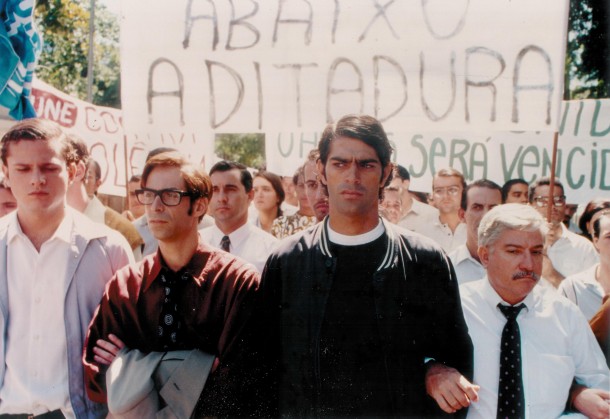
The opening credits may tell us that jails are filled with political prisoners and the streets are filled with activists, but we are given no examples or reasons for dissent. We aren’t told explicitly what avenues to change could work but we are told that armed resistance only legitimizes the coup. Without any rationality for the group’s origins, the militia becomes entirely motivated by emotion rather than logical and strategic thought. According to the film, the only reason Gabeira came up with the idea to kidnap the ambassador was because his friend was captured in a bank heist and he wanted to find a way to get enough leverage to get him out. The only rational thinkers in the group are depicted as being emotionless and evil. Jonas, the new leader from São Paulo, often leads with rational thought, weighing human lives with group gains and forbidding disobedience. This group mentality only succeeds in breaking the psyche of some of their most devoted followers.
Those, that in reality caused the most harm, the military officials and American envoys, don’t seem nearly as evil as Jonas. Ambassador Elbrick appears as the ideal of democracy. He is just doing his job, believes the US should not support non-democratic countries, and knows nothing about any American-led torture programs. There are fleeting scenes of torture and even then it is conducted by middle-management guys who don’t have an ideological stake in the matter. There is no evil CIA figure to make Gabeira and his comrades seem like anything other than bourgeois kids out for some fun. There are no out-and-out villains on the other side. In fact, before Elbrick is captured, he makes a comment about the time he was working in Romania and that even though it was tumultuous, “even vampires recognize diplomatic immunity.” The military-sponsored torturers may be bad, but the guerrilla fighters are worse than vampires.

The flaws of this film become even more apparent when compared to a similar film about a guerrilla group in South America, State of Siege. Though most of the names in this film are changed, this 1972 French film directed by the master political filmmaker, Costa Gavras, follows the Uruguayan guerrilla group, the Tupamaros, as they kidnap Dan Mitrione, a US government official sent to train local police in torture. Gavras, who understands that every action is political, is able to craft a story that understands the flaws of a movement and the reasons for it. If the laws of physics dictate that for every action there is an equal and opposite reaction, it is adequately proven in this film. O Que É Isso, Companheiro only seems to prove that any attempt to create an apolitical world only reinforces the actions of those in power.
 The Cine Latino Blog
One response to “The Depoliticized Guerrillas of O Que É Isso, Companheiro?”
[…] For the English version, click here […]
LikeLike