

Para la versión en español, cliquea aquí
Synopsis
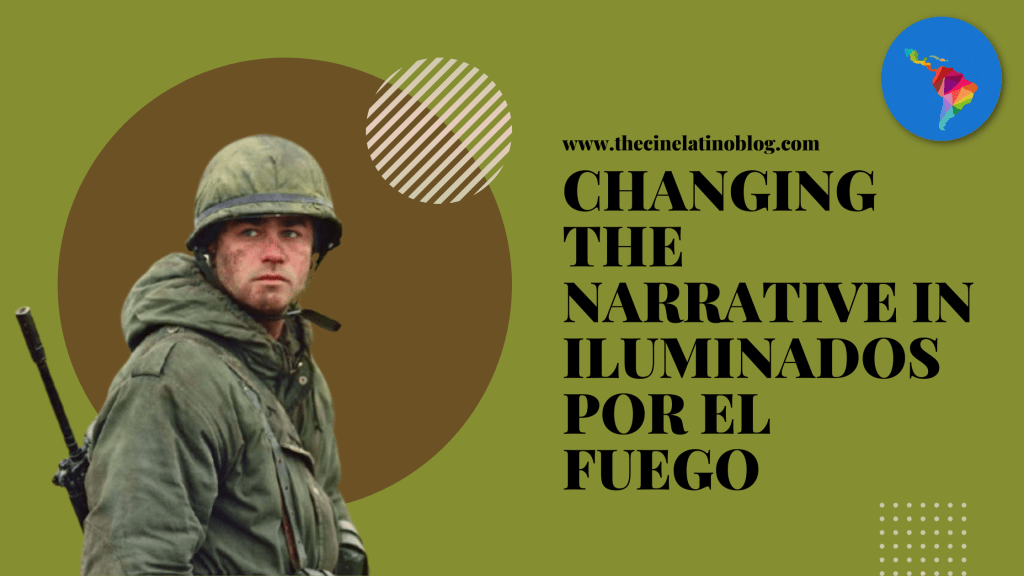
Iluminados Por El Fuego (2005) follows Esteban, a middle-aged journalist who is thrust back into the past when he receives news that his old war buddy has committed suicide. Suddenly, memories of the doomed Falkland War come flooding back and he must deal with it once and for all.
Ask any Argentine, and you will realize the call of the Malvinas didn’t first sound in 1982. This was something that had been brewing in the nation almost since its birth with the first claims for the island coming in the 1830s. However, this dispute with England over the ownership of the islands was relatively uneventful, save a few incidents, until 1976, when Argentina established an unauthorized but unopposed presence in the South Sandwich Islands, consequently the same year that the Argentine people fell into the hands of a brutal military dictatorship. 1982 represented a breaking point in many ways: both for the return of Argentine democracy and the devastation in the Malvinas.
The dictatorship and particularly, General Galtieri, used these islands as a pawn and a final bid to redirect the attention of his people and regain support following years of misinformation and state-sponsored violence. He turned to the easiest method: war. In a patriotic haze, Argentina quickly invaded the islands in April 1982 before the English were any wiser, declared victory, and celebrated an early win. However, the celebrations were shortlived and Prime Minister Margaret Thatcher’s robust response ended the war in a little over 2 months leaving 649 Argentines dead, serving as both a much-needed boost for her government and a death knell for the Argentine. The government ultimately failed but bought time by changing its own narrative and causing a war. In response, Argentina honors the fallen and the veterans on April 2nd, but the war itself is still shrouded in secrecy and shame.

Iluminados Por El Fuego is director Tristán Bauer’s way of reframing a narrative the dictatorship used long ago and asking his country to look back and think of the many consequences that war has had. It is for that very reason, that Bauer’s film takes place in two timelines: from April to June 1982 as well as the more recent past, 2001, another infamous year for the Argentine people. Banks defaulted, politicians including the president escaped with their heads in their hands, and the people took to the streets to protest the government whose actions had created one of the worst economic crises in the country’s history. Shot like a documentary and following Esteban, a veteran and current journalist, Bauer asks his audience to re-evaluate the past by making this apt comparison between two societies separated by time but alike in turmoil.
Personally, it is Esteban’s own friend, Alberto Vargas’ suicide attempt that awakens him. This violent attack jolts his memory and leads him to say “Las Malvinas volvió una vez más y lo cubro todo” or “Las Malvinas came back once again and covered everything.” From that point on, the movie is split in two with flashbacks bringing Esteban back to the war. From his point of view, we see that it was as life-changing as it was shortlived. In the moments before taking the plane down to the islands, Esteban rushed out of line, claiming he had to go to the bathroom, and instead called his mother one last time. He was still very much a child. When we cut to one month later, and see his worn out, tired, and dirty face in a close-up, we see a lifetime of pain.
Iluminados Por El Fuego frames war the same way All Quiet On the Western Front does. A lot of the direct violence is of course the fault of their English foes who, as we see in the shaky and realistic camera footage employed in the film, rain down bombs and cause chaotic and horrifying scenes below, but the source of the most insidious evil are their commanders. These are the men who try to convince their troops through lies and propaganda that their fight is not in vain. After years of torturing their own people, many of these sergeants are more preoccupied with making their platoon’s lives hell rather than the enemies’ and Vargas is the biggest victim of this. A gentle soul, he can’t take the physical punishments or the imposed mental hardship like not being allowed to say goodbye to his family before leaving.

Rather than realize the errors of their ways, their superiors actually relish in their cruelty and gode their subordinates like Vargas by asking him if he knows how many men he has killed. As Esteban so aptly puts it, the mental breakdown of Vargas, the death of their friend Chamorro, and their epic defeat are not their own fault but the fault of the incompetent officers leading the way. This is perfectly encapsulated in one of the first wartime scenes we see when the soldiers are being given a motivational speech that is as harsh as it is uninspiring. Their commanding officer declares that neither hunger nor exhaustion exists, only God and the homeland. The next second, a British plane ambushes the group leaving them defenseless. Their words have done nothing against the British onslaught.
The war comes to an end with little fanfare as the officers hide away and all that is left are the soldiers who are not welcomed like heroes. Instead, they return with secrets and leave a mess of guns, helmets, and bodies behind on the islands. Ironically, the voiceover of their commanding officer says, “por esto, lo que han vivido aquí, los va a acompañar siempre” or “for this, what you have experienced here, will always be with you.” How true these words were, they could not know. For Vargas, the war changed everything. His dreams of starting a family with his sweetheart seemed naive and years of economic hardship led him to become a mentally ill and sometimes abusive man with several suicide attempts. In fact, when comparing two of Vargas’ hospital visits, one during the war and the other after his last suicide attempt, they look just as frantic and overwhelming. Nothing has changed. Vargas was only one of more than 200 veterans of the war to end his own life.

In the end, Vargas dies, leaving Esteban wondering about the last time they spoke and Vargas’ final wish: to return to the Malvinas. To get rid of the ghosts that haunt him, Esteban will have to go back and confront the past he tried to bury. What he finds is an island very different from when he left it. No longer dreary, cold, and isolated, he sees the beauty of the sunny towns full of people and the destruction he left behind for them, including landmines that they have not been able to clean up. All of this culminates in an emotional visit to an old foxhole as well as the grave of his old friend, Chamorro. Greater than guns or fighter jets or even political repression is the power of memory. Even in the devastation of 2001, there is hope in the images of crowds coming together in anger, unlike the faceless crowds of the 1980s that blindly went to war. This is the only way to keep the ghosts at bay and have a chance for the future.
 The Cine Latino Blog
One response to “Changing the Narrative in Iluminados Por El Fuego”
[…] For the English version, click here […]
LikeLike