

Para la versión en español, cliquea aquí
Synopsis
Historias Mínimas (2002) follows three travelers: an old man, a young mother, and a traveling salesman, as they journey through Patagonia, looking for different things.
Patagonia, the region of Argentina and Chile which makes up most of the southern half of South America, is a land of vast open spaces, diverse tribes, and tons of mystery. Even its name reminds the world how mythological legends can become a reality. Stemming from Magellan’s chronicles of his voyage to Latin America, fellow explorer and survivor of the voyage, Antonio Pigafetta claimed to have recorded the presence of giants in the region, supposedly the Tehuelche people who, according to Pigafetta, measured between 9 and 12 feet tall. Thus the name Patagonia or “land of the big feet” was born. For hundreds of years, the rumors of these Latin American giants persisted until scientific research finally concluded that while taller than average, the Teheuelche people were certainly not giants. It’s no wonder that since then, this land has been the center of Quixotic adventure in big and small ways.
Director Carlos Sorin may be a native to the bustling Buenos Aires, but he made a cinematic home out of Patagonia. He even featured the region in several of his movies, including the inaugural Goya Award winner for Best Iberoamerican Film, La Pelicula del Rey, about a director set on making a film about the legendary Frenchman, Orélie-Antoine de Tounens, who became the King of Patagonia, either out of malice, integrity, or true insanity. The heroes of Historias Mínimas may not be as grand as a famous director or a French explorer, but their desires are just as expansive as theirs. Even side characters we never meet have strange and hard-to-reach hopes and dreams, like the husband of an old widow, who became obsessed with the cultivation of palm trees as he believed Patagonia would one day look like Brazil.
It’s hard to imagine that a tropical paradise could ever be born in this flat, desert space. Still, there is something inherently mystical in Sorin’s vision of Patagonia, as a place that makes you search and believe, no matter how foolish. Sorin’s protagonists are displaced members of society: an old man who is no longer allowed to drive, a young mother living without electrical power, and a traveling salesman with a bygone job. With the quintessentially Argentine guitar music composed by Sorin’s own son, playing throughout the film, as well as the film’s use of almost entirely local, non-professional actors, it’s hard to deny how deeply embedded Patagonian myths and identity are in this story.
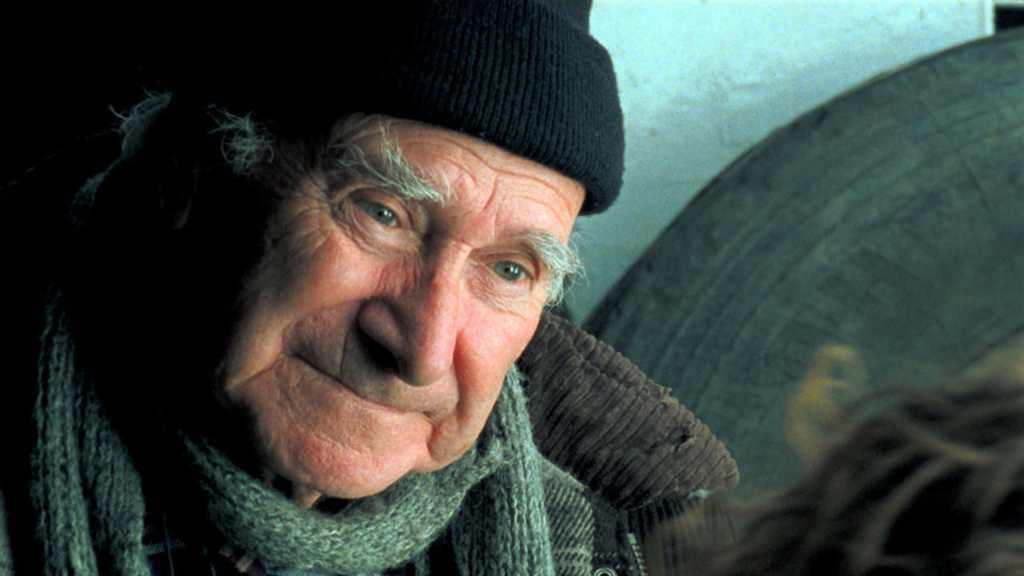
The old man, Don Justo’s quixotic quest for his lost dog is a perfect encapsulation of these ideas. In his current state, he is ‘useless’ to society. He is retired and babied to the point that his daughter-in-law even feels the need to cut his meat for him at dinner. Having recently had his driver’s license taken away after failing an eye exam, he is doomed to a sedentary life of sitting outside the general store he used to run, a constant reminder of the independence he has lost. Until, one day, an old friend recognizes him and tells him that he saw his dog, Mala Cara, or “Ugly Face”, years after he ran away. Against all the odds and with only a pair of hiking boots he inexplicably owns, he escapes while his son is sleeping, and sets off on foot to find his elusive dog.
Our modern Odysseus may not face one-eyed monsters or seductive sirens, but his own modern hurdles make his journey eventful. From well-meaning strangers who take him to a hospital or an overanxious salesman who takes him on a detour, his journey is not simple. It is all in pursuit of something greater than himself. His quest is to understand the mystery of his dog. As he puts it, rather simply, he wants to know if dogs can understand things. Near the end of the movie, we learn why and the reason is both more ordinary and tragic than we could have thought. As he tells it, the eye exam that took away his license was forced on him by a local sheriff with nothing better to do. On his way home from the exam, the solution in his eyes made his vision blurred and he hit someone. He didn’t stop. He just kept driving and the only witness was his faithful dog who spent the following night howling and vanished the next day.
A Patagonian version of David Lynch’s The Straight Story, Don Justo is a humble man who just wants one last reunion with his faithful companion and hopefully, a shot at forgiveness before he dies. Whereas other explorers looked for a mythical creature, Don Justo is looking for an ordinary dog whose company seems just as illusive. His reunion is rather unceremonious and he is forced to give up a sum in a decidedly dubious exchange. There are no tears or clear signs that things will be able to go back to normal, but there is another chance to understand the enigma of his wild dog.
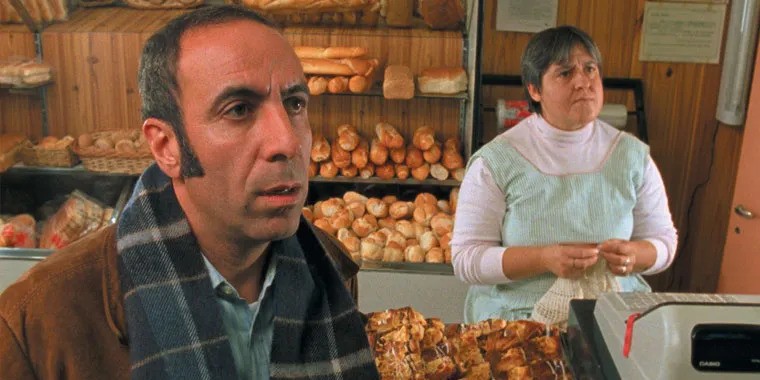
Don Justo’s brief companion on his trip is another person in search of company: a traveling salesman named Roberto. His job and way of life are fading away, but he clings to it as well as his inspirational platitudes about believing in yourself and working hard that he tries to sell to his clients, friends, and himself. What he wants more than anything is for a local widow to fall for him. To woo her, he decides to show up to her child’s birthday party with a cake, but this turns out to be a comically complicated task for this overanxious traveler. First, he worries about the penmanship on the cake, then he wonders if the name Rene is for a boy or a girl and panics about the design. In the end, after all that worrying, his fear gets the best of him and he doesn’t even show up. He gives up, only to meet her the next day at her store and fall in love all over again. It’s unlikely he will ever win her but he will continue rolling the boulder up the hill and enjoy doing it.
To round out the group, Sorin introduces us to Maria, a young mother who lives off the grid with her husband, a day laborer. Through a stroke of luck, she ends up winning a spot on a Patagonian game show with the chance to win a number of items including a food processor. Though she and many of her friends don’t even know what that is or how to use it, they are excited nonetheless. She is in search of material goods but she finds a different, less glamorous studio than she thought. Treated like cattle, she does win a processor but is not given any indication as to where she can receive it. She finally receives a makeup set from a rather aggressive contestant deadset on the processor and returns to the bus where Don Justo and his trusted dog are also riding.

In one of the final shots, Maria sees herself through the compact mirror with a look that is hard to figure out. Is she proud of her accomplished journey or sickened by the world of greed that she has just passed through? The same goes for Don Justo, who as the director Sorin put it, could be simply sleeping or sitting there dead on the bus. It’s an ending that synthesizes the ordinary lives that have sprouted in the region with its own mythological origins. Patagonia is rich with stories, some true, some fake, but all captivating.
 The Cine Latino Blog
One response to “Historias Mínimas: A Patagonian Passage”
[…] For the English version, click here […]
LikeLike