


Para la versión en español, cliquea aquí
Synopsis
Based on a true story, Plata Quemada (2000) follows two criminal partners and tumultuous lovers, Ángel and El Nene, who enlist in a big-time bank robbery. When the hold-up turns bloody, the men along with their crew must flee the country and find a way out.
In 1965, a group of young criminals participated in a hold-up in Buenos Aires. After the bank heist, they escaped to Montevideo where they tried to hide until they were found out on November 6. A huge group of Uruguayan police surrounded them, and a shooting took place, leaving the three remaining thieves dead in a blaze of glory. All were buried anonymously except for one, who came from a rich family in Argentina, and whose body was sent back home. While its ending was exciting, it was not unlike most stories of famous young thieves who met a fiery end, except for one detail that was revealed by the police. Two of the macho, gun-wielding victims were found half-naked and holding hands.
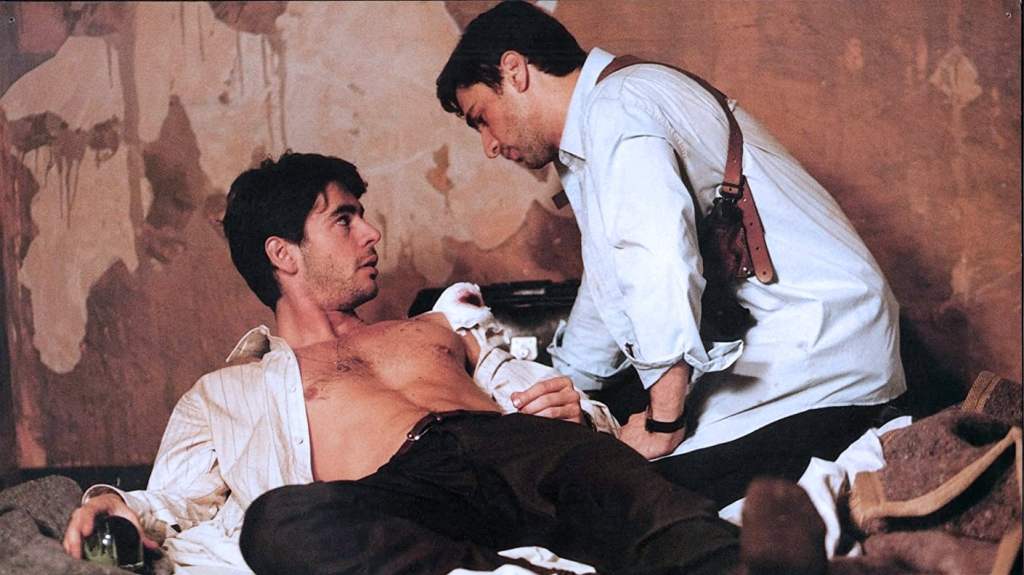
This was a particularly striking detail since the mid-1960s were especially machista in Argentina. Democracy was precarious after the ousting of Perón ten years earlier, and the following years saw a procession of five short-lived presidencies. The next year, a military dictatorship would be installed, putting an end to this period of uncertainty. While this time brought economic insecurity, it also proved to be especially dangerous for gay men. After the death of Eva Perón in 1952, the last sympathetic idol for women and gay men was taken out of the government. In the late 60s, several government measures and laws against LGBT rights would be carried out and by 1965, public bathrooms and movie theaters would be the only acceptable spaces for gay men.
This is the world and the story that inspired famed writer, Ricardo Piglia to publish his own novel, Plata Quemada (1997), with a few major alterations. With that small but incisive detail of the two men dying holding hands, Piglia added his own backstory and posited the two men as long-time lovers. He also made the severe mental illness and possible schizophrenia of one of them a major part of the rupture of their relationship. Piglia wrote in these two major character details even though there was no factual basis for this because these fabrications helped to hold a very true mirror to 1990s Argentine society. In this neoliberal world where profit is prized above everything else, the country’s political leaders become modern symbols of criminality, much like our immoral but misunderstood protagonists. It didn’t take long before Marcelo Piñeyro, the director of other major Argentine films like Cenizas del Paraiso, decided to adapt the novel for the big screen.
Our two criminal partners, El Nene and Ángel are not just viewed as different because of their sexual preferences, but their own outsider perspectives. Ángel is a rich boy who somehow found himself in the criminal underworld and El Nene is a Spanish immigrant who hears voices. Even in the criminal world, they seem out of place with independent, macho standards. The music employed by the film reflects this as well. Though their love is underscored by a famous tango standard, “Vida Mia”, it is sung by a woman, breaking with the tradition of the time. Their relationship may be an open secret, but neither they nor their colleagues ever refer to the true nature of their bond. They are instead given the nickname, “the twins” rather than “the lovers”.

But for however out of place and isolated these men may seem, the movie posits that their homosexuality forms a natural link with their criminal identity. In a time where gay activity would only be possible in public bathrooms late at night, it would be very easy for someone from a rich family to turn to stick-ups and murders. El Nene even says that prison is where he “learned to be gay”. Even in the hyper-masculine criminal underworld, there is more sexual liberation and freedom behind bars. Meanwhile, Ángel, a schizophrenic who often turns to drugs to dim the voices, meets El Nene when he is in need of a fix.
Though their sexuality is deeply embedded in their life, they still try to reject that part of themselves, especially after a nearly fatal accident that takes place during their robbery. Going against the criminal code, when Ángel is shot, El Nene does not leave him for dead but instead brings him back to their safe house and delays their escape in order to treat him. Their love creates a precarious situation for everyone involved as well as a chasm in their own relationship. Though Ángel had been sexually distant in the lead-up to the robbery, the break with underworld society rules makes him even more ashamed to be physical with El Nene. Ángel turns to the church and seemingly religious bloodletting rituals while El Nene turns to Giselle, a beautiful prostitute he meets late at a carnival.
It’s tragic to watch them twist and turn in order to shape themselves into the men they feel they need to be, but they are not the only ones. The only other young criminal in their group, El Cuervo, is straight and wants everyone to know it. When the group is stuck in a safe house in Argentina with his girlfriend, he cares little if they are caught having sex with the door open. Let everyone know who in this house is a real man. This attitude doesn’t pay off in the least. His devoted girlfriend sticks to the criminal code and guiltlessly gives them up to the police the second they interrogate her. Like El Nene and Ángel, he dies in a shootout with the police, but not clinging to his beloved. Instead, in a moment of clarity before dying, all he can do is brag to the cops shooting him that he will die rich with money he will never be able to use.
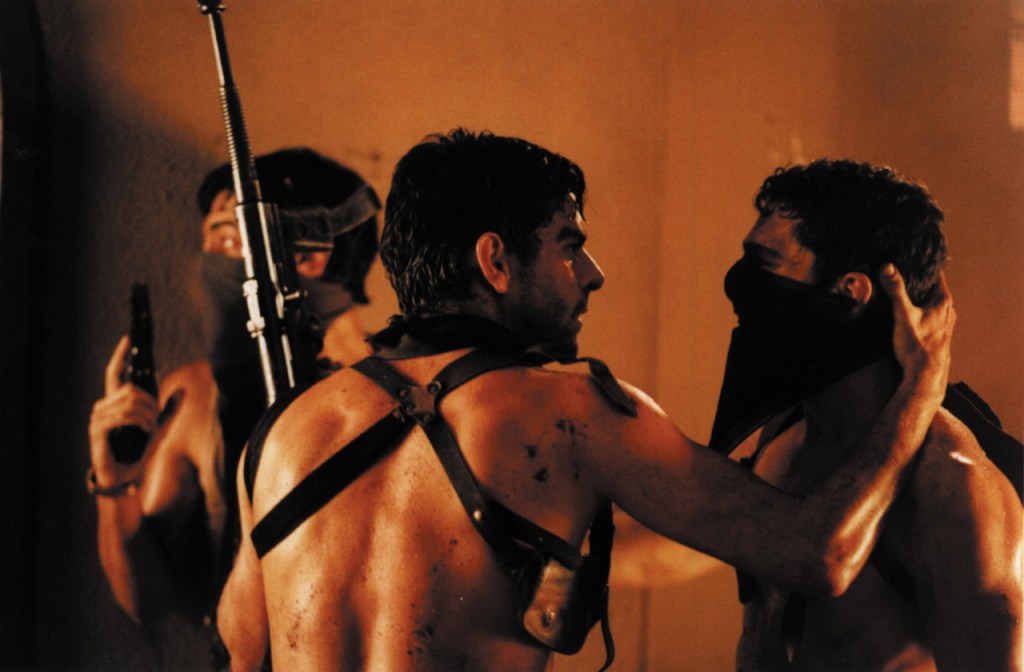
The excitement of the shootout does not bring El Cuervo any realizations about the constricting nature of society. It does not free him, but it does do something for El Nene and Ángel, who in the excitement, unashamedly regain their sex drive. Their biggest tragedy is that it will have to remain unconsummated as the mob of armored cars outside leaves no time for anything else. Finally, after burning their clothes and realizing they won’t get away, they burn the remaining money. Society be damned and the criminal underworld be damned. They will forego every law that persecutes them. Unfortunately, rejecting society has a price. Argentina has no room for these men and the next phase of its history will continue without them. However, their blaze of glory and final embrace remain among the rubble, reminding everyone that in death, heroes and villains look the same.
 The Cine Latino Blog
One response to “Criminality in Plata Quemada”
[…] For the English version, click here […]
LikeLike