


Para la versión en español, cliquea aquí
Synopsis
Lo Que Importa Es Vivir (1987) follows Candelario, a drifter who, after spending the night at the hacienda of Don Lazaro, gets a job there. He soon turns the place around and earns the respect and trust of Don Lazaro. However, when he begins an affair with the boss’ wife, the equilibrium of the hacienda is threatened by gossip, betrayal, and impending violence.
Our story begins when we see a lone drifter carrying a rucksack along a dirt road. The image of this lone heroic man of the people figure is so striking that the film shows it twice. This scene is mirrored at the end of the movie when our protagonist, Candelario, after living the severe ups and downs of life in an hacienda, abandons everything with just a rucksack and his small son, this time hoping to find a better future for both of them. As Candelario repeats his walk to the unknown and says goodbye to his past yet again, one can’t help but see the parallels between Candelario’s journey and that of the film’s director Luis Alcoriza.

Alcoriza was born in Badajoz, Spain to a theatrical family. Originally an actor, Alcoriza traveled with his theater company across Spain and the world, including countries across Latin America and the north of Africa. However, his jaunt across the world was put on hold with the disastrous Spanish Civil War and his subsequent exile. Alcoriza became one of the many intellectuals to flee Spain for Mexico, just in time for a kind of renaissance in Mexican cinema. In the 1940s, production of Mexican films rose from 29 releases in 1940 to 70 in 1943 and 83 in 1945 thanks to recently strengthened political ties with the US, whose studios helped to support the Golden Age of Mexican Cinema. It was around this time that Alcoriza met Luis Buñuel, the famous director of such classics like Un Chien Andalou. Alcoriza collaborated on the scripts for several of his most iconic Mexican films of the 1950s like Los Olvidados and Él.
Still, Alcoriza’s real moment in the spotlight came in the 1960s when the recent Cuban Revolution meant the young storytellers of Mexico were looking past standard American melodrama and at revolutionary movies focused on the underappreciated workers of the country. Alcoriza directed several classics including the Academy Award nominated film, Tlayucan, about a poor man who turns to crime in a desperate attempt to cure his son’s illness. Throughout this decade, Alcoriza continued to make films that questioned the fruits of the Mexican Revolution and delved into the country’s deep-seated class, gender, and race problems. While the 1960s birthed a master director of Mexican cinema, by the 1980s, the industry and Alcoriza himself, were a lot more worn down. The 1980s brought an economic downturn caused by external debts and the film industry suffered with it. Alcoriza would go on to end his career in Spain and so, though Lo Que Importa Es Vivir does not reach the artistic heights of his previous work, it remains significant as one of his last messages to the Mexican people.
In Lo Que Importa Es Vivir, Alcoriza reflects on the ups and downs of life in a rural hacienda. Thanks to Don Lazaro’s mismanagement, his workers cannot find peace in their connection to the land. In fact, most of the pleasant moments early on in the film come while the characters are indoors, away from the land and from the town square. Candelario even remarks to Mama Rosita on his first night that he wishes the hacienda ran as smoothly as her kitchen. On the outside, farmworkers are unhappy while most of the town’s rich sit in the square drinking and gossiping about every minute drama. For Alcoriza, a society full of money men who run farmlands without knowing how to grow things is not one we should want to be a part of.
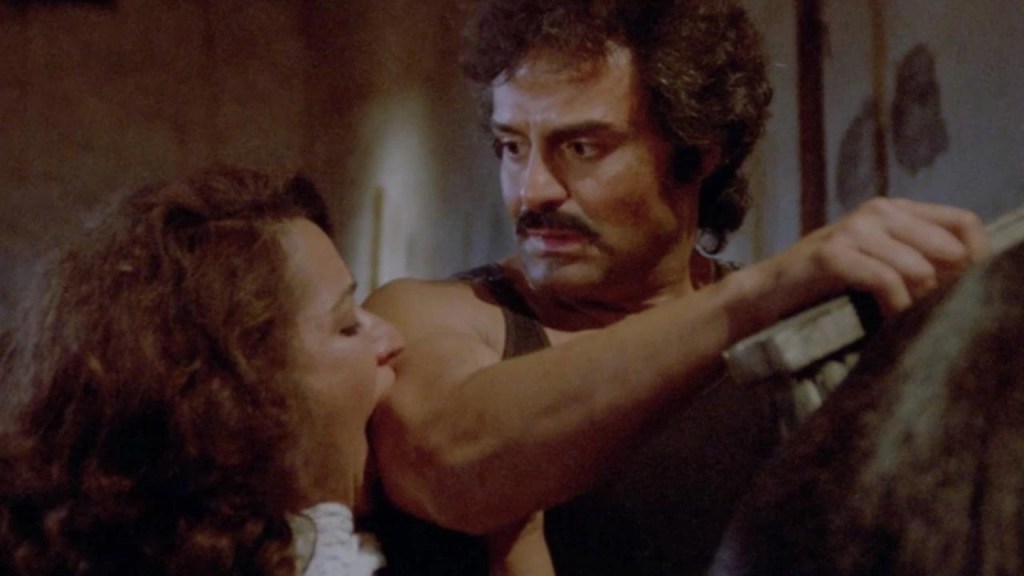
Candelario is not driven by his need for acceptance. The more he learns about the farmlands and gives in to his deep animal desires, the happier he becomes. When he begins his affair with Don Lazaro’s wife, Chabela, he is grooming horses in the stable. Suddenly, Chabela appears and begins to bite and lick his arm until they are overcome with passion. It’s a juxtaposition too obvious to ignore. When their affair is revealed by Don Lazaro’s gossiping friends, it appears as though things have taken a turn for the worse. Don Lazaro confronts Candelario with a gun and tragically slips and falls off a cliff. He barely survives but pays the price by losing his memory and becoming a virtual toddler.
In most of these tragic affair stories like Therese Raquin in which the two lovers are forced to live with a silent reminder of their love’s consequences, it ends very badly. Alcoriza turns the story on its head. Though this event leads to Chabela being banished from her Church, their life ends up changing for the better. When Chabela gives birth to Candelario’s baby, Lazaro proves to be a doting “older brother”. The accident gives him a new lease on life and he becomes a happy new member of their family. Likewise, Candelario’s workers in the hacienda are happier than ever as he does not give in to threats from neighboring haciendas and he pays them more than they’re used to. They are living in their own little paradise until tragedy strikes and Lazaro dies in a freak horse riding accident.
United in mourning, the townswomen who forbade Chabela from the church now want to make amends and though Candelario is livid, Chabela accepts immediately. Her acceptance leads inevitably to Canderlario’s isolation and separation. When Chabela finally gets to plan her wedding with Canderlario, she buys him an extravagant traditional outfit he despises and invites everyone that shunned them in recent years. Subsequently, Candelario spends most of the wedding at Lazaro’s grave rather than at his party. The final straw comes when Chabela goes shopping with her new friends and comes back with new outfits not only for him but his young son.

In order to make sure his son is not infected by this hypocritical upper class, he has to leave, abandoning his wife, and his new high status position among the hacienda owners. And so, we return to the same road we came from, this time with a small companion. He may be lost but he is more optimistic and headstrong in his convictions than before. Though the film’s melodrama leans a little too extreme, its meta ending which symbolizes a goodbye from Alcoriza is powerful. We know now that the wilderness of 1980s Mexican cinema would lead to a boom in the 90s, but back then it was an unknown. Maybe Alcoriza had a feeling that somehow, the industry was going to come out better on the other side.
 The Cine Latino Blog
One response to “Saying Goodbye in Lo Que Importa Es Vivir”
[…] For the English version, click here […]
LikeLike